
In his centennial year, what Theodorakis’s catalog teaches us about the difference between music that is famous and music that can be played.
Mikis Theodorakis wanted to write a song. It was December 1969, he was interned in a detention camp at Oropos, and he had no manuscript paper. So he took an ordinary sheet, ruled the staves himself by hand, and wrote the music on them. The autograph survives in his archive, signed and dated, staves and all.
There is a version of that story people tell as pure romance: the imprisoned composer, the improvised page, art surviving the camp. It is a good story and it is true. But there is a second story inside it that almost nobody tells, and it is the one we think about constantly in our work.
Before he could write a single note, he had to build the manuscript page.
That is where engraving begins. It is not a finishing touch applied once the music is done. It is the physical and intellectual infrastructure that has to exist before music can be transmitted to anyone at all. Composers have often done their own copying. Theodorakis did his in a detention camp, with paper he had to prepare himself, for works the state had banned.
His centennial year has produced an enormous amount of writing about his politics, his poetry settings, his exile and his songs. Almost none of it is about how his music got onto the engraved page. That is worth correcting, because his catalog is one of the clearest case studies in music history for a question composers, estates and publishers ask constantly: why does music engraving matter if the music already exists?
The composer who did his own copying
Gail Holst-Warhaft played harpsichord in Theodorakis’s orchestra and has written about him for fifty years. Describing her time in the Athens archive looking at the original materials for Axion Esti, she recalls something that stopped her: pencil parts, in his hand, for timpani, for the violins, for the horn. He wrote out the instrumental parts himself because at that stage of his life he could not afford a copyist.
She is direct about what that means. It is labor, and it is tedious labor. It is also, in her account, inseparable from the discipline that let him produce a catalog of that size. He got up in the morning and he worked.
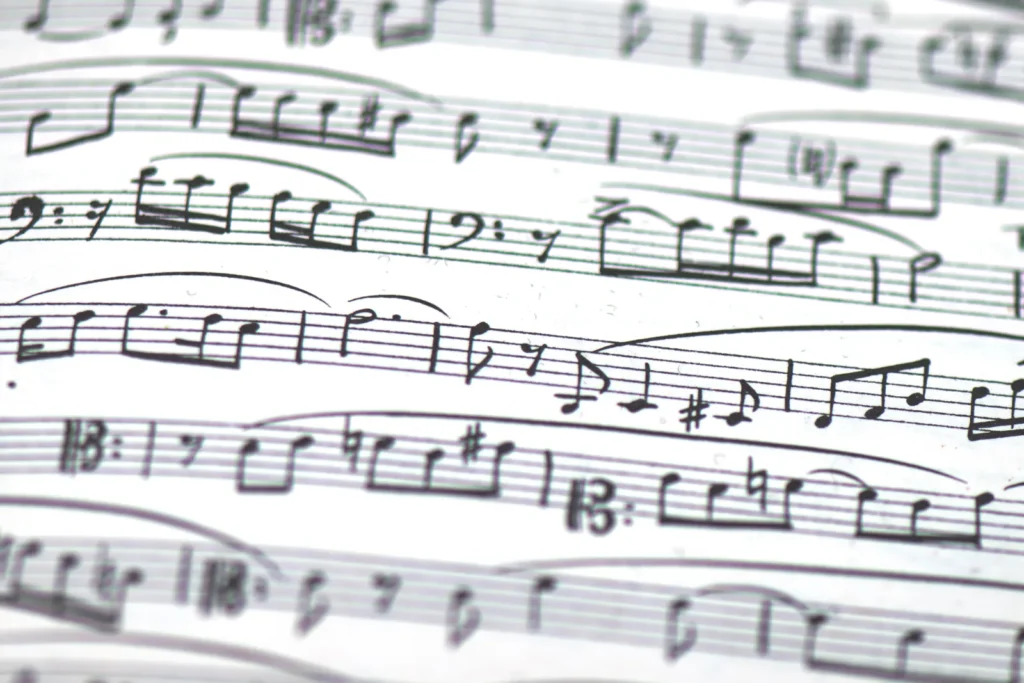
The image is worth staying with. This is the composer of Zorba, a man who would be nominated for the Nobel Peace Prize and released from prison after an international campaign backed by Shostakovich and Bernstein, sitting with a pencil, ruling bar lines and copying out a horn part one note at a time.
He was not doing it because he enjoyed it. He was doing it because the parts had to exist, and there was no one else to write them. It reflects something many composers still resist: a finished work in the composer’s own hand is not yet a work anyone else can perform. It is a private document. The copying and preparation of parts is what turns a private document into a public one.
We write this with some direct knowledge of the material. ScoreMasters has engraved Theodorakis’s music. Every professional music engraving brief that comes to us is a version of that same act. The technology has changed completely. The obligation has not.
Famous by recording, silent on the page
Here is the paradox at the center of Theodorakis’s career.
By the mid-1960s he was one of the most widely heard composers alive. Zorba the Greek had gone around the world. Epitaphios had sold in numbers that shook Greek cultural life. Dalida, Jean Ferrat, Georges Moustaki, Nana Mouskouri and Irene Papas were all singing his music in translation. Melina Mercouri had made his sound synonymous with Greece for a generation of European listeners.
And yet a conductor in Stuttgart or Melbourne who wanted to program his large-scale works often could not, because the materials to do so did not exist in usable form.
Stefania Merakou, who directed the Music Library of Greece for nearly two decades and curated the exhibition My Galaxy: Mikis Theodorakis at the Megaron in 2021, puts the principle in one sentence we would happily engrave on our studio wall. If a musician or a conductor or a pianist has the work in print, then they can simply play it. And she adds the qualifier that matters most.
It is not a given that a work is printed at all.
She treats the fact that major international houses eventually took his catalog into print as genuinely significant, not as an administrative footnote. She is right, and the reason is worth spelling out.
A recording tells the world that a piece exists. Only a score lets the world perform it.
The gap between those two things can be measured in decades. Axion Esti, the oratorio that is arguably his central achievement, was composed at the start of the 1960s. A printed full score appeared in 1974, from Editions Monde Musique, during his exile and international touring, and for years it was the practical blueprint for performances abroad, circulating largely as photocopies. The full study score most performers work from today, 364 pages from Schott, was not published until 2013, with a Greek co-edition through Romanos, Philippos Nakas. More than fifty years separate the composition from the edition.
The consequences of that gap are not hypothetical. Tatiana Papageorgiou, who holds a doctorate on his piano and symphonic music and worked with him closely for over twenty years, describes her research in terms that are startlingly editorial for a concert pianist. Her work involved unearthing unpublished works, doing music editorial work, producing arrangements, transcriptions and orchestrations, and only then giving world premiere performances, several with the composer himself conducting.
Note the order. The premiere comes last, after the unearthing, the editing and the preparation.
Works by a living, world-famous composer sat unperformed until somebody did the editorial and engraving labor required to make them playable. Not unwritten. Not lost. Unprepared.
This is the single most useful thing Theodorakis has to teach anyone considering a music engraving service. Note that this was not a problem that surfaced later. He was alive, famous and conducting, and works of his still went unperformed until somebody prepared them. If your catalog lives as recordings, as digital audio workstation (DAW) sessions, as MIDI files, as pages in your own hand, then you have documented that the music exists. What you have not yet done is put it in front of the musicians who could program it, commission it, or take it into their repertoire. That is not a question of legacy. It is a question of reach and how much of your catalog can earn.
When standard music engraving conventions aren’t enough
The second reason Theodorakis belongs in this conversation is technical, and it is the reason we find his catalog truly instructive rather than just inspiring.
Again and again, he forced material onto the staff that Western notation was never designed to carry.
It started in the prison camps. He first listened seriously to rebetiko while imprisoned on Makronissos, and that is also when he began notating it. Consider what that involves. A young composer trained in Western art music, transcribing by ear an urban tradition that had never been written down, whose rhythmic identity lives in a nine-beat cycle that does not sit comfortably in any standard barring convention, whose ornamentation is idiomatic to a plucked instrument, and whose modal language does not map cleanly onto major and minor key signatures.
That is a transcription and engraving problem of the first order, and he was solving it in a detention camp.
It did not get simpler when he was free. The tradition he was drawing on was largely oral. As Holst-Warhaft notes, most of the musicians in that world did not read notation at all. They were superb and they were reliable, and they worked entirely by ear. So Theodorakis was writing music that had to function simultaneously for players who read fluently and players who did not, and often in the same ensemble.
When Epitaphios reached its premiere, the symphonic musicians of the radio orchestra walked out of the first rehearsal rather than share a platform with a bouzouki and a nightclub singer. They came back only under threat of dismissal. The score was asking for something the institution had no category for.
His mature works pushed further. He described his later large pieces to the American broadcaster Bruce Duffie as symphonies-oratorios, in which a symphony orchestra, a chorus, soloists, and a small popular ensemble all operate within a single work. In the same conversation, he described his film scoring method: separate instrumental groups, each with its own thematic material, entering at different points, one at eight seconds and another at thirteen, conducted independently and designed to lock together contrapuntally.
Now put that on a page. Not a page for the composer, who already knows how it goes, but one an orchestra can rehearse from on the first morning without him standing there to explain it.
We list these not as trivia but because they are precisely the problems that land on our desk. Composers and publishers come to our music engraving studio when the notation is not standard: hybrid ensembles that mix orchestral and traditional instruments on one system, non-Western modal material that resists conventional accidental and key-signature practice, additive and asymmetric meters that need barring decisions before they need engraving decisions, plucked and folk instruments that need idiomatic notation rather than generic staff writing, and cue systems for ensembles that do not enter together.
And then there is text.
Theodorakis was, above all, a composer of sung poetry. Ritsos, Elytis, Seferis, Neruda in Spanish, Kambanellis. His vocal works travel internationally, which means his scores have to carry Greek text, transliterated Greek, and singing translations, frequently on the same page and frequently under the same notes.
Anyone who has actually done this knows that it is where the work most often comes undone. Greek diacritics and elision, syllable division that follows the source language rather than English convention, lyric extenders and hyphens that behave correctly across scripts, multiple text layers that stay legible and correctly aligned when a singer is sight-reading under pressure, vertical spacing that does not collapse when a second or third language is added. None of this is solved by typing words under noteheads and letting the software space them.
If your catalog involves vocal parts in languages other than English, or notation that does not fit the default templates, this is not a special case for us. It is the center of our work. Theodorakis’s output is the most visible proof we know that this work requires someone who understands both the notation and the language.
Why a digitized score is not a performing edition
On 15 December 1997, Theodorakis donated his personal archive to the Music Library of Greece “Lilian Voudouri” at the Megaron in Athens.
It is a remarkable act of foresight and an extraordinary collection. Manuscript scores and texts, correspondence, press cuttings, posters, programs, audiovisual material, photographs, medals, even his conducting baton. Stefania Merakou, who received it when the library was still new, describes a relationship built on trust: he was proud to have done it, he was satisfied with the conditions of safekeeping, and he never interfered in the cataloging work.
Since then the material has been sorted, classified, conserved and digitized. His manuscripts are online. The library’s digital collection now runs to hundreds of thousands of items, freely accessible, and researchers around the world use it.
This is one of the best outcomes any composer’s archive has ever had. We want to be completely clear about that before we say the next thing.
A digitized manuscript is not a performing edition.
You can look at a scan of an autograph. You cannot put it on ninety music stands and rehearse from it on a Tuesday morning. A conductor cannot mark it. A librarian cannot extract parts from it. A page-turn will fall in the wrong place. Transpositions will be in concert pitch or not, inconsistently. Divisi will be ambiguous. Corrections and revisions will exist as layers of pencil that only their author could reliably interpret.
Preservation and performability are two different projects. The archive solves the first one magnificently. The second one is still, work by work, a music engraving job.
This is the confusion we encounter most often, and it is getting worse rather than better as scanning becomes trivial. Scanning feels like the finish line. It is closer to the starting line. Between the scan and the rehearsal there is a body of skilled labor: editorial decisions, layout, spacing, part extraction, cueing, proofreading against sources, and the hundred small conventions that keep a player’s eyes moving instead of stopping.
When we take on archival and estate work, that is exactly the gap we are closing. The material is there. Our job is to make it usable.
What this means if you are not Theodorakis
Most composers do not have an archive in a national library. What they have is more fragile: recordings of works that were never written down, session files, draft notation files that were never finished, handwritten scores with no parts extracted, and parts written quickly for one performance and never cleaned up.
Theodorakis’s career offers three lessons, and none of them are sentimental.
The first is that preparing the score and parts is part of the work, not a chore appended to it. He copied his own parts by hand, in pencil, and in a detention camp he ruled his own staves. Music that cannot be transmitted has not finished happening.
The second is that fame does not confer performability. He was one of the most heard composers of the twentieth century while significant portions of his catalog sat waiting for someone to prepare them. Recordings spread his music. Editions are what let other musicians take it up and perform it, and those editions arrived late, and it took dedicated specialists to produce them.
The third is that difficulty is not a reason to postpone. His music is genuinely challenging to notate. Hybrid ensembles, oral traditions, asymmetric meters, multiple languages, non-standard performance practice. It got engraved anyway, and that is why conductors can program it today.
If any part of your catalog currently lives only as audio, only in your handwriting, or only in a form no musician or ensemble could rehearse from, then you are in the same position he was, at a smaller scale and with better tools available.
We built our music engraving service around exactly this gap. Orchestral and choral engraving, part extraction and preparation, transcription from recordings and manuscript, and specialist work on scores that involve non-standard notation or vocal texts in languages other than English. We have been doing this internationally since 1997, for composers, publishers, orchestras and estates.
If you want to know what preparing one of your works would involve, send us the material. Whatever you have, handwritten, scanned, exported, or a recording with no notation at all. We will look at what is there, tell you plainly what the notation will require, and give you a realistic picture of the scope before you commit to anything.
Theodorakis ruled his own staves because nobody else could. Today, that part is ours.
Frequently asked questions
What is music engraving?
Music engraving is the professional preparation of a score and its parts for performance: layout, spacing, part extraction, cueing, page turns, and the notation conventions that let a musician read at sight without stopping. It is the step between a finished composition and a performable score.
Why do I need a music engraving service if my score already exists?
A score can exist and still be unusable. A handwritten manuscript, a scanned PDF, or a notation file exported without preparation cannot be rehearsed from by an orchestra. Engraving turns a document only its author can read into one any ensemble can perform from.
Can you engrave vocal scores in languages other than English?
Yes. Multilingual vocal engraving is a specialty at ScoreMasters, covering Greek, Arabic, French and other scripts, including diacritics, source-language syllable division, transliteration lines, and multiple text layers under the same notes.
Can you produce a score from a recording?
Yes. Transcription from audio, MIDI or DAW sessions into a fully engraved score and parts is a standard part of our work.