
AI Music to Score
Any AI-generated track into performance-ready sheet music, score and parts.
where the track ends, the score begins
- Every note checked by a human ear
- Preparing scores since 1997
- Arranged for live players since 1998
From a finished track to parts for live musicians.
Suno, Eleven Music, Mureka, AIVA, and similar platforms generate finished audio: a mixed recording, often complete with vocals, lyrics, and full production. Some also export stems, MIDI files, DAW sessions, and even a basic score, but these are machine estimates of the notes, not parts a musician can read. AI audio also brings problems of its own. Inner lines of the accompaniment appear in one section and vanish in the next, rhythm-section parts change pattern for no musical reason, and whole instruments sit so deep in the mix that they can barely be heard. Automatic transcription reads all of this literally, which is why its output rarely reaches a rehearsal without being rewritten.
ScoreMasters® converts the output of any AI music generator into properly engraved sheet music, from a lead sheet or piano-vocal score to a full ensemble score, with lyrics under every vocal line and parts ready for rehearsal, recording, or publication. Our credentialed musicians notate every line by ear, keep what the AI got right, and resolve what it did not: inner voices are made consistent, rhythm-section parts are made musically coherent from start to finish, and buried lines are brought back into the texture, always in the style of your track. When your project calls for more, we add orchestration or arranging, whether that means a fuller string section, a new countermelody, or a version for a different ensemble altogether. Whether AI is your creative starting point or one stage in your production workflow, the score and parts that leave our studio are ready for live musicians, and every project includes a complimentary audio mockup.
Our team has turned audio, MIDI files, and DAW sessions into finished scores for artists such as Kitt Wakeley and Stefanos Korkolis, and an AI project often draws on more of that experience than the transcription alone: Orchestration & Arranging if the track needs rewriting for your ensemble, Music Engraving & Score Preparation if the score is heading for print, Music Transcription if other parts of the project exist only as recordings, and MIDI to Score if your platform has already given you MIDI files, stems, or a DAW session. Send us what you have, and we will recommend the right combination.
From AI track to finished score.
A Prayer for Peace, an instrumental piece generated in Suno, with additional orchestration by ScoreMasters®, scored for flute, piano, strings, drums, and electric bass.
AI Original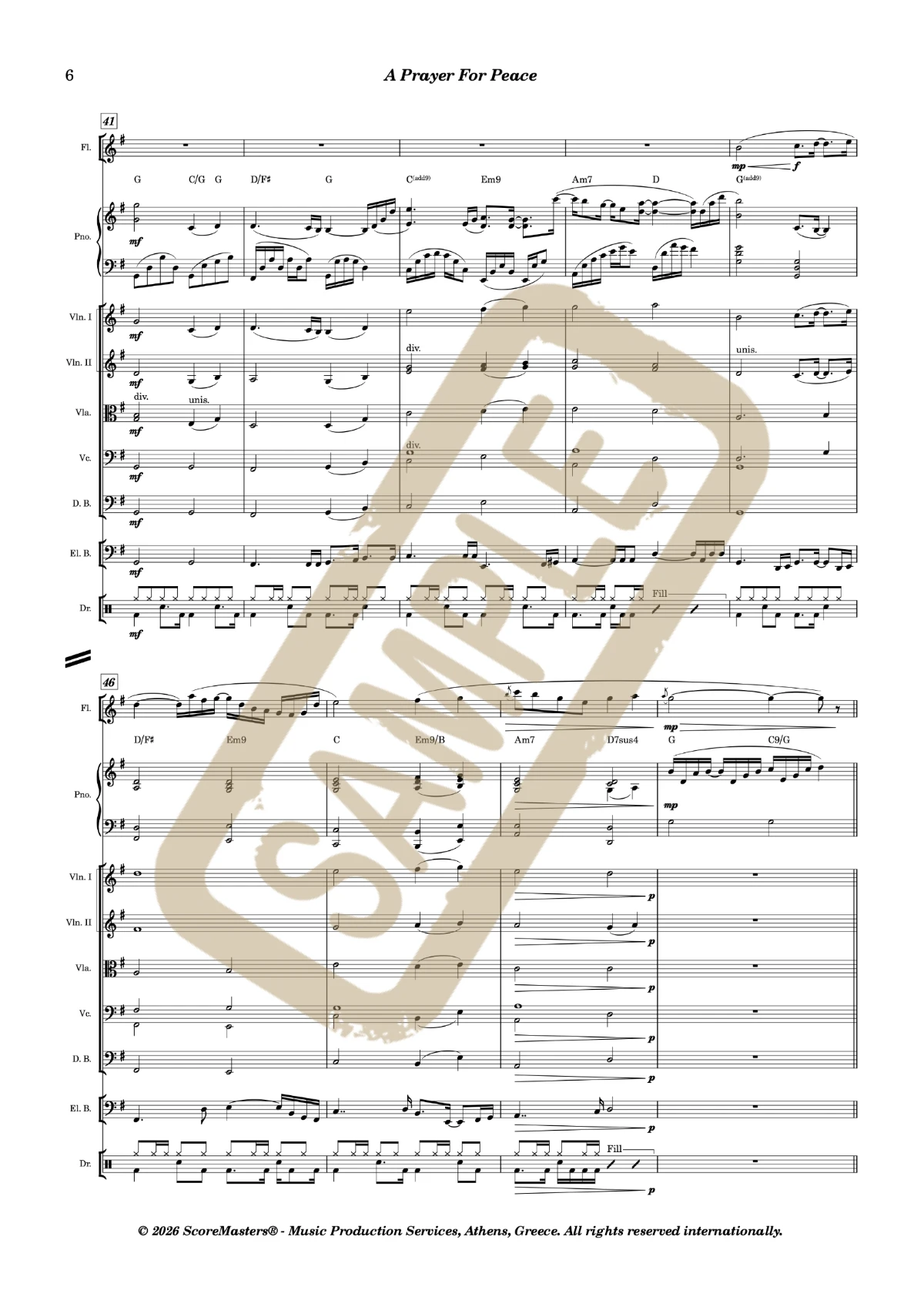 Click to enlarge
Keys by the Door, a rock song with R&B influences generated with Google's Lyria 3.5, notated as a lead sheet with the vocal melody, lyrics, and chord symbols.
AI Original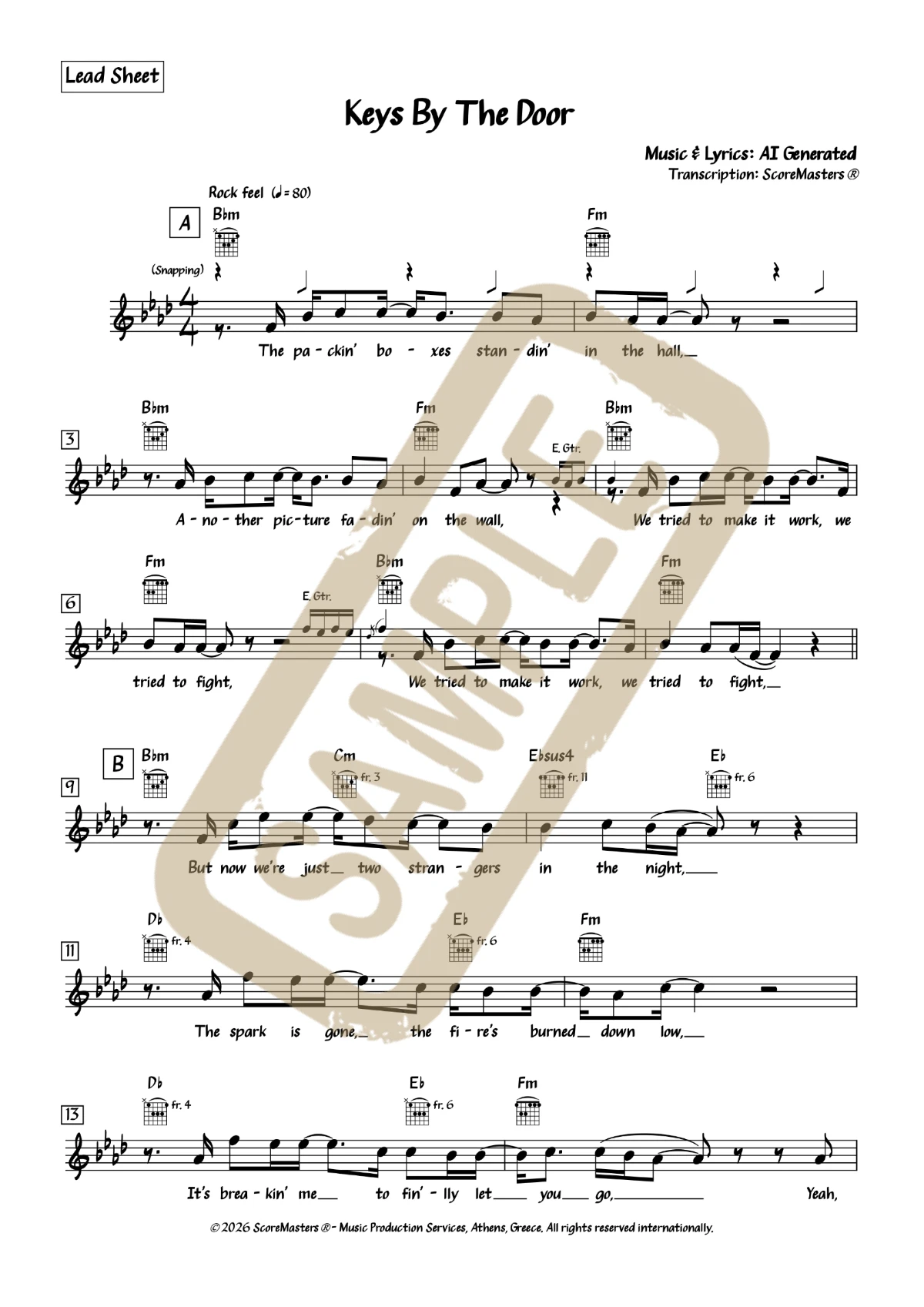 Click to enlarge
Every AI track is different.
So is the reason for scoring it.
Film, TV & Game Composers
Finished a cue on your own themes with the help of AI? Turn it into a session-ready score and parts, with every line checked for live players.
Music Publishers & Rights-Holders
Prepare publication-ready notation for works in your catalog where AI assisted with the arrangement or orchestration of material you own.
Musical Theater, Songwriters, Artists & Producers
Wrote the lyrics, the melody, or both, and let AI build the production? Get the song as a lead sheet or piano-vocal score for your band, your singer, or your next release.
Classical & Concert Composers
Completed a work of your own with the help of AI? Receive a concert-ready full score and parts, with the orchestration refined wherever live players need it.
Ensembles, Choirs & Orchestras
Perform an AI-assisted song or piece live, from parts written for your actual lineup, with every AI inconsistency resolved musically.
Educators & Institutions
Turn an AI track from a student project into notation your class can study, rehearse, and perform with live instruments.
Sacred Music
Give your worship team chord charts, piano-vocal scores, or choir parts for a song you wrote with the help of AI.
Four Steps: The ScoreMasters® Brief System
Send Your Files
Share your material in any format (audio, MIDI, PDF, or handwritten sketches) and tell us about your project. Our form walks you through everything we need.
Get Your Quote
Within 12 hours, Samy personally reviews your material and replies with a transparent quote: scope, deliverables, format, timeline, revision policy, and final price (in USD, EUR, or GBP).
Approve, Then We Craft
Once you approve and place your order, work begins. On larger projects, you'll see a draft at the midpoint, with the chance to course-correct before final delivery. Two rounds of revisions are always included.
Receive Final Files
Your completed score arrives with a free audio mockup and in every format you requested: PDF, MIDI, MusicXML, and editable Dorico, Sibelius, or Finale files. Ready to rehearse, record, publish, or perform.
What it costs, and what you receive.
AI Music to Score
The three tiers below cover our most-requested formats, from a lead sheet to a full score and parts. More on fees, rush delivery, revisions, copyright, discounts, and payments is on the Pricing page.
From $35€30£26 per min · 3–5 business days
- Lead sheet$35€30£26 per min · 3–5 business days
- Piano-vocal score$65€57£49 per min · 3–6 business days
- Ensemble/band score & parts$85€75£64 per min · 3–7 business days
What’s included
- Print-ready PDF files
- A standard audio mockup
- Engraved score and parts with full markings
- Lyrics for each vocal line, where present
- Every note checked by ear against your track
- The editable project files if you hold the copyright
What affects the fee
- The instruments involved
- The number of concurrent voices
- The duration of the piece
- The audio quality
- The overall complexity
- Any orchestration or arranging the project needs
- The requested deadline
What clients ask before commissioning a score from an AI track.
Is there a difference between AI Music to Score and Music Transcription?
Yes. Music Transcription is faithful to the source note for note: what the recording plays is what the score shows. AI Music to Score starts the same way, with every line notated by ear, but it also corrects what the AI got wrong or left unclear, such as inner parts that change from one section to the next or instruments too buried in the mix to be heard properly, and it can include orchestration or arranging when your project needs it. The aim is a score that works for live musicians while staying true to the style of your track. If you want an AI track notated exactly as it sounds, flaws included, ask for our Music Transcription service instead.
Does AI Music to Score include orchestration or arranging?
Yes, when your project needs it. AI generators are often inconsistent with the inner lines of an orchestral or instrumental accompaniment, and with rhythm-section parts too, and some lines are mixed so low that they are barely audible. We resolve these problems as part of the service, always in the style of your track. If you want to go further, with a fuller orchestration, a new countermelody, or a version for a different ensemble, we include that too, and we agree the scope with you before we start.
What file formats do you work from?
An audio file, ideally a high-quality WAV. MP3 files are fine too, but MP3 compression discards detail, and AI-generated audio already has less detail than a studio recording, so a WAV makes a real difference where you have one. If your platform exports MIDI, stems, or a DAW session with stems, send those as well. We use them as a reference, but every part is still checked by ear against the audio, because machine-extracted MIDI often misreads dense mixes. For songs, include the lyrics as text.
What file formats do you deliver?
You receive print-ready scores and parts and a complimentary audio mockup. Editable project files (MIDI, MusicXML, and the native notation file) are included when you hold the copyright to the source material. If you do not, we can agree separately, for an additional fee, to deliver the editable project files you need.
What affects the price of AI Music to Score?
The fee depends on the instruments involved, the number of concurrent voices, the duration of the piece, the audio quality of the track, how much orchestration or arranging the project needs, the overall complexity, and the requested deadline.
Will I receive an audio mockup of the final score?
Yes. Our standard delivery includes an audio mockup at no charge, so you can hear the score and compare it with the original track before anyone plays it.
Can’t software turn my AI track into sheet music automatically?
Automatic tools exist, and some platforms export MIDI or even a basic score, but they work by estimating pitch and rhythm from finished audio. On a dense, fully produced AI mix they regularly misjudge rhythms, harmonies, and which instrument is playing which line, and they cannot tell a deliberate musical idea from an inconsistency the AI introduced. We check every note by ear and make those judgments as musicians.
Which AI music platforms do you work with?
Any platform whose output you can download, including Suno, Eleven Music, Mureka, AIVA, and Google’s Lyria. The platform matters less than the quality of the files, so send the best versions your plan allows.
Can I copyright or publish sheet music of an AI-generated song?
It depends on who created what, and we cannot give legal advice. As of this writing (2026), under current US Copyright Office guidance, material generated entirely by AI is not protected by copyright, and writing prompts does not count as authorship, while your own human contributions, such as lyrics or a melody you wrote, remain protected. Rules differ from country to country, and your AI platform’s terms matter too: Suno, for example, limits songs made on its free plan to non-commercial use. We prepare the score either way. If you plan to register, publish, or sell the music, check your platform’s current terms and take advice from a copyright professional.
Do you transcribe the lyrics of vocal tracks, solo or choir, and in which languages?
Yes. Lyrics are typeset under each vocal part. We handle most major languages in-house, including Arabic, English, French, German, Greek, Hebrew, Portuguese, and Spanish. If your language is not one we cover in-house, we find and supervise a professional typesetter for it.
Can you create a piano reduction of an orchestral AI track?
Yes. We prepare piano reductions for rehearsal, study, and publication, created once the score is finalized and approved. Our reductions preserve the essential harmonies and voice leading, the melodies and countermelodies, and the rhythms, dynamics, articulations, and markings a pianist depends on.
Can you adapt the music for my players or a different ensemble?
Yes. We can simplify parts for students or amateur players, rewrite the music for the instruments you actually have, or transpose it to suit a singer. This is part of the service when you need it, and it is included in your quote.
When will I receive the sheet music, or the score and parts?
The usual turnaround is 3–5 business days. The exact timeline depends on the instruments involved, the duration of the piece, the audio quality, the overall complexity, and whether orchestration or arranging is part of the job.
Does the AI Music to Score service include revisions?
Yes. Accuracy is guaranteed, and every project includes two rounds of revisions at no extra cost, covering normal adjustments of interpretation and taste as well as any genuine error measured against your source material and the agreed scope.
How do I start?
Send us the audio, the lyrics if the track has vocals, and a short brief on what the score is for, whether that is a lead sheet for a singer, parts for your band, or a full score for an ensemble. Tell us whether you want the track notated as it stands or reworked for particular players, and when you need it. We reply with a fixed quote and a delivery date.
Services that pair with AI Music to Score.
-
Music Orchestration & Arranging
Sketches, piano parts, lead sheets, or MIDI into full arrangements for any instrumentation.
-
Music Engraving & Score Preparation
Rough notation, handwritten manuscripts, or music notation files into clean, publication-quality scores and parts.
-
Music Transcription
Audio, MIDI, video, or live performance converted into accurate sheet music, every note by ear.
-
MIDI to Score
Your DAW production into a session-ready score, with the articulations, voicing, and page turns notation exports miss.